
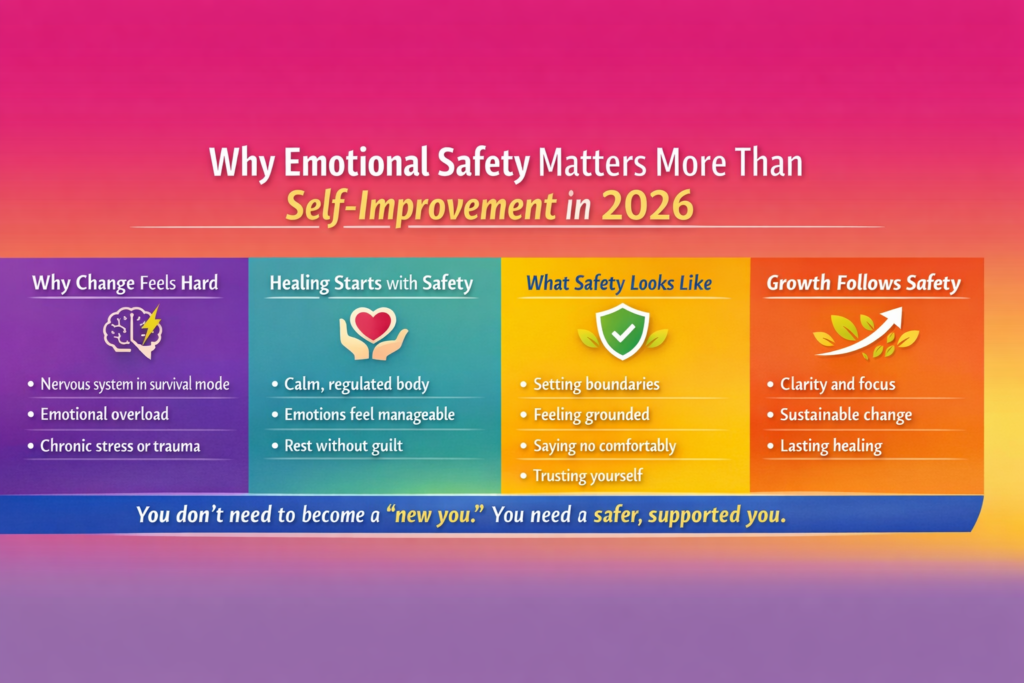
As a new year approaches, many people begin reflecting on what they should change about themselves. The focus is often on improvement—better habits, more discipline, greater productivity, emotional strength.
Clinically, this focus misses something essential.
For many individuals, especially those who have lived with chronic stress, trauma, emotional neglect, burnout, or neurodivergence, the difficulty is not a lack of effort. It is a nervous system that has spent too long in a state of alert, protection, or exhaustion.
When the body remains in survival mode, change does not feel motivating.
It feels unsafe.
When Self-Improvement Feels Like Pressure
A nervous system shaped by prolonged stress prioritises protection over growth. This can show up as:
- Difficulty sustaining routines or goals
- Emotional overwhelm or shutdown
- Constant self-criticism despite effort
- Guilt when resting
- Feeling “stuck” even when life appears stable
These responses are not signs of weakness or failure.
They are adaptive responses to prolonged strain.
From a mental health perspective, pushing for change without addressing safety often leads to repeated cycles of motivation and collapse.
Healing Begins With Safety, Not Reinvention
True healing does not require becoming someone new.
It requires creating a sense of internal safety—a state in which the nervous system is no longer preparing for threat.
When safety is present, the system can:
- Regulate emotions more effectively
- Rest and recover without guilt
- Make decisions with clarity rather than fear
- Engage in change without force
This is why trauma-informed therapy prioritizes stabilization and regulation before goals or behavioural change.
Growth becomes sustainable only when the system feels safe enough to support it.
Why Goals Often Fail Without Nervous System Regulation
Traditional goal-setting assumes that the mind is in control.
Neuroscience tells us otherwise.
When the nervous system is dysregulated:
- Focus decreases
- Motivation becomes inconsistent
- Emotional reactions intensify
- Cognitive strategies alone are insufficient
In these states, the body overrides intention.
This is why many people experience frustration around New Year goals—not because they lack commitment, but because their system does not yet have the capacity to hold change.
What a Safer 2026 Can Look Like
A safer year may not look dramatic or externally impressive.
Clinically, it often involves:
- Reducing pressure rather than increasing demands
- Prioritising emotional regulation over performance
- Recognising limits without shame
- Understanding capacity before setting expectations
- Allowing healing to be gradual and non-linear
Safety creates the foundation from which meaningful and lasting change can occur.
Therapy as a Process of Stabilisation
Therapy is often misunderstood as a place to “fix” problems or correct behaviour.
In trauma-informed work, therapy is primarily about:
- Helping the nervous system exit survival mode
- Making emotions tolerable rather than overwhelming
- Increasing internal stability and resilience
- Restoring a sense of agency and self-trust
When safety is established, growth follows organically.
A Different Question for 2026
Instead of asking:
“What should I improve about myself this year?”
A more clinically useful question is:
“What does my nervous system need to feel steady enough to move forward?”
The answer may involve rest, boundaries, support, or therapeutic work.
None of these indicates failure.
They indicate self-awareness.
You Are Not Falling Behind
If pushing harder has not worked in the past, the solution is not more pressure.
2026 does not require a reinvented version of you.
It requires a regulated, supported, and safer one.
Healing is not about doing more.
It is about creating the conditions in which change can finally hold.