
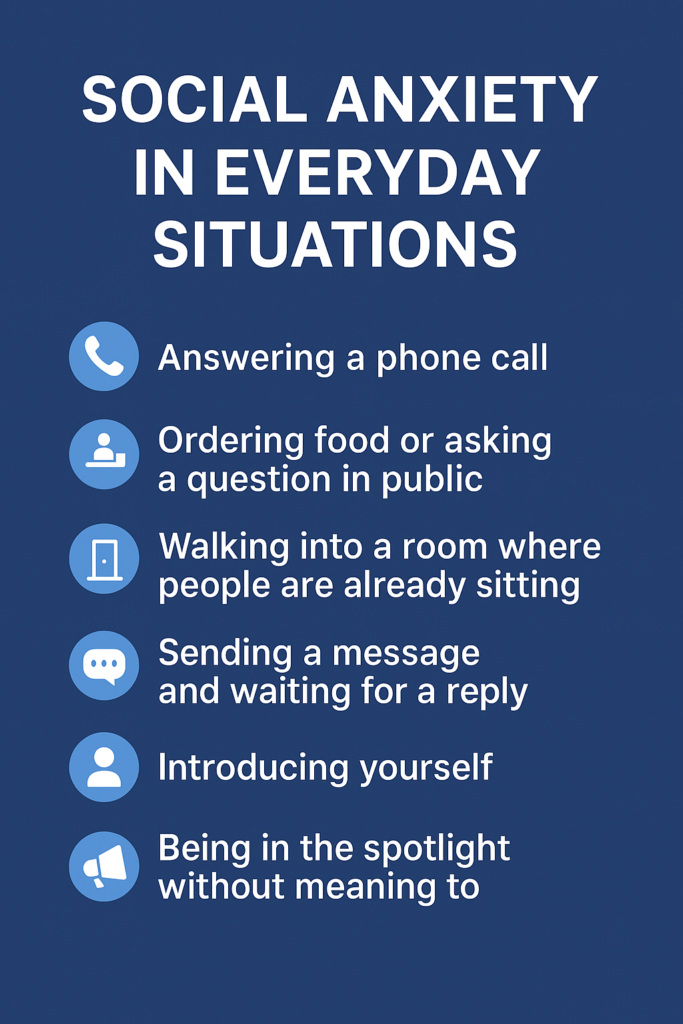
Social Anxiety in Daily Life
We often imagine social anxiety as something big—public speaking, meeting large crowds, or walking onto a stage.
But in reality, social anxiety shows up in small, everyday moments, often quietly, subtly, and privately.
These are the situations people rarely talk about, yet they affect so many of us.
The Hidden Moments Where Anxiety Shows Up
Here are some common everyday experiences where social anxiety slips in:
1. Answering a Phone Call
Even a simple call can create a sudden wave of nervousness:
“What do I say?”
“How do I sound?”
“What if I mess up my words?”
2. Ordering Food or Asking a Question in Public
For many, approaching a counter or asking for help can feel overwhelming.
Not because it’s difficult—but because it feels like all eyes are on you.
3. Walking Into a Room Where People Are Already Sitting
That moment when you enter a meeting late or join a group…
Your heart races, your mind rushes, and you suddenly worry about how you’re being perceived.
4. Sending a Message and Waiting for a Reply
Social anxiety isn’t always face-to-face.
Sometimes it’s overthinking:
“Did I sound rude?”
“Are they upset?”
“Why haven’t they replied yet?”
5. Introducing Yourself
Even adults hesitate with simple introductions, especially in formal or new environments.
The fear of “being judged” makes us overly cautious, even if the situation is safe.
6. Being in the Spotlight Without Meaning To
Someone compliments you.
Someone asks your opinion.
Suddenly, your brain freezes—not because you don’t know the answer, but because all attention feels intense.
Why Does This Happen?
Because social anxiety is not about the situation—it’s about the internal pressure to appear “right,” “likeable,” or “perfect.”
It comes from:
- fear of judgment
- past experiences
- high expectations from self
- sensitivity to social cues
- wanting to belong
And these pressures show up in moments where others might not see anything wrong.
What Helps?
Here are gentle skills that reduce everyday social anxiety:
✔ Take slow breaths before engaging
A calmer body supports a calmer mind.
✔ Prepare simple “go-to” phrases
Especially for calls, introductions, or ordering.
✔ Challenge the inner critic
Most people are too busy with their own lives to judge us.
✔ Practice small exposures
Gradually face the situations you avoid.
Small steps build confidence.
✔ Offer yourself compassion
Social anxiety doesn’t mean you’re weak.
It means your nervous system needs safety and reassurance.
A Final Thought
Social anxiety is far more common than we realise.
People may look confident on the outside while feeling overwhelmed inside.
By talking about these everyday moments, we normalise the human experience and allow space for gentleness, understanding, and growth.
If you experience social anxiety—even in the smallest situations—you’re not alone, and you’re not “overreacting.”
You’re human. And you deserve support.